We build software that runs the work.
Sparcgen is a small software studio. We build production systems for work that has to be right the first time — clinical submissions, federal proposals, business operations — and a motorcycle route planner, because we wanted one. We run our own company on all of it before we sell any of it.
The Portfolio
// 05 modules · all in productionSPARC Flagship
Governed biostatistics computing environment — AI-driven ADaM, TLFs, and validated release for regulated clinical trials.
VoXorian
AI proposal management & writing. Win more proposals — without the all-nighters.
SyliFlow
Agentic business orchestration. Run like a large corporation — under full command.
Throttle Rides
Motorcycle route planning that finds the curves — then rides on Google Maps.
acaDMY
Electronic quality management and training — Part 11 signatures, tamper-evident audit, and compliance evidence on demand.
Command Center
Program delivery and portfolio operations — every program, risk, and deliverable in one live picture, before it hits your timeline.
How we build
// the short versionDeterministic by design
Pinned toolchains and hashed inputs mean a run rebuilds to the same bytes a year later. AI speeds the work up; determinism keeps it trustworthy long after.
Governed by default
Access, changes, and releases are controls the system enforces, not conventions people are trusted to follow. Everything is attributable, every release signed.
AI where it earns its place
Models draft and generate inside structured metadata and hard guardrails, reviewed by a person or checked by a separate system before it counts.
We run on it first
Every product runs a real business before it ships. If it can't survive our own operations, it doesn't ship.
// PORTFOLIO · 05 modules
The Products.
Five in production, more on the way. Each is a company-grade product that Sparcgen designs, builds, runs, and supports — several already running real businesses.
SPARC Flagship
Governed biostatistics computing environment — RBAC, version control, validated Dev→QA→Prod, with AI doing the production work inside the rails. CDISC-native; 21 CFR Part 11 by construction.
VoXorian
AI proposal management & writing — federal capture, Section L/M matrices, grants, and semantic reuse across everything you've written.
SyliFlow
Agentic business orchestration — coordinate agents and teams across operations, under full command and audit.
Throttle Rides
Motorcycle route planning that finds the curves — then hands you turn-by-turn on Google Maps.
acaDMY
Electronic quality management system plus workforce training — 21 CFR Part 11 signatures, tamper-evident audit, and one-click compliance evidence.
Command Center
Program delivery & portfolio operations — studies, deliverables, milestones, risk, budget, and governance in one shared, audited picture. The delivery cockpit K3 runs on.
MOD-01 · Clinical biometrics · ● Live
SPARC
The environment where a clinical trial's statistics get built, checked, and signed.
The interface
// SG-SPARC · screen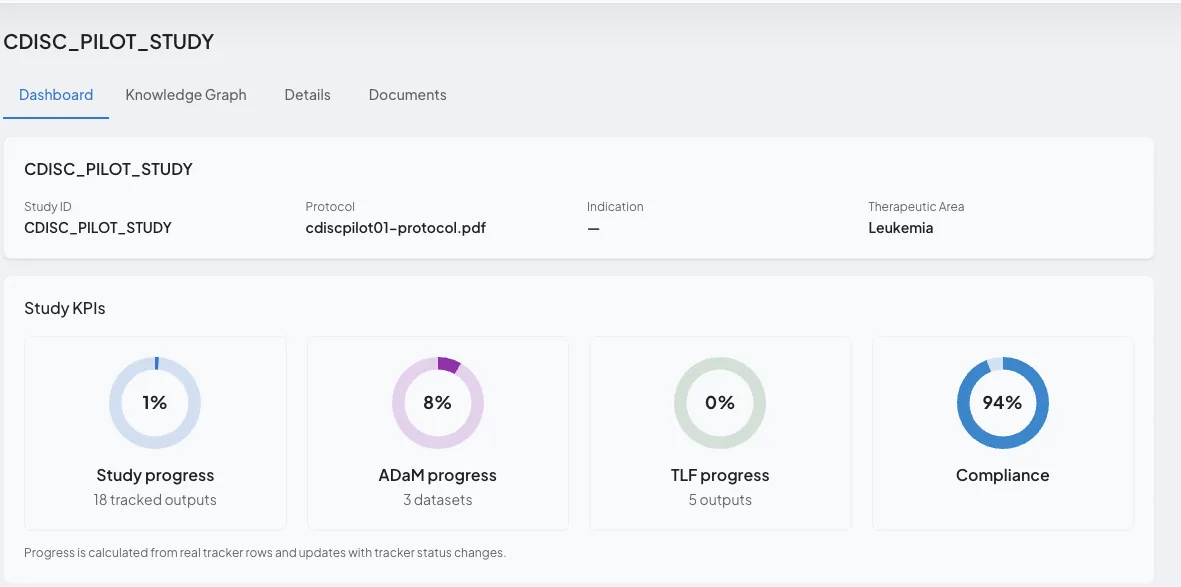
A clinical trial ends in a stack of datasets and tables that have to be exactly right. The ADaM datasets and the TLFs — the tables, listings and figures — are what a regulator reads to decide whether a drug worked. The usual way to produce them is slow and almost entirely by hand: programmers rebuild the same outputs every time a specification changes, and a second team reprograms them independently to catch what the first team missed. A single overlooked CDISC rule can hold a submission up for weeks.
SPARC is where that work happens under rules the system enforces, instead of rules people are trusted to remember. Programmers still run it. What changes is that an AI model drafts the ADaM specifications and the R that produces them, working from the study's analysis plan and a knowledge base of CDISC rules, so the output starts out conformant rather than being corrected later. Everything runs on pinned versions of R and SAS. Critical outputs are still double-programmed and reconciled to an exact match, and nothing reaches production until a person signs it under 21 CFR Part 11.
Because every run records its inputs, its seed and its package versions, you can rebuild any result a year later and get the same bytes back. Access, edits and releases are all logged, so an auditor can follow any number to the exact code and data behind it. SPARC runs the biometrics of K3 Innovations, an AI-native CRO — the environment a working CRO files real submissions from, which is the test that actually counts.
Specification
// SG-SPARC · datasheetWhat's inside
// SPARC · modulesSAP ingestion
Analysis plans are parsed from PDF into hierarchical sections and mapped into TLF shells, so the plan and the outputs stay connected instead of drifting apart.
ADaM specifications
Specs authored or AI-drafted with value-level metadata, codelists, and derivations; validated against reference standards and promoted between workspaces.
Code generation
Composable generators build the analysis program — datasets, subsets, titles, analysis sets, exports — with a planning step ahead of code and an LLM assist where it helps.
Execution
R and SAS 9.4 execution services produce RTF tables, listings, and figures, with Python supported alongside them.
Error remediation
Execution failures are logged, matched against previously resolved errors, and returned with a suggested fix rather than a raw traceback.
CoCreate
A pair-programming workspace: chat beside the editor with per-change accept or reject on a diff, so the programmer stays in control of what lands.
Lineage
Variable-level lineage from SDTM through ADaM to each display, with origin and computation method, rendered as a navigable graph.
Dashboards
An interactive lens over the governed environment — patient profile, safety, efficacy, and lab views explored without code, from study overview down to the individual patient.
In production
// measured, not projectedThese come from SPARC running a working CRO's biometrics, not from a benchmark. What gets faster is the manual rebuilding. What stays slow, on purpose, is the checking: independent QC, conformance, and the signature that puts a name on the release.
MOD-02 · Proposals & capture · ● Live
VoXorian
AI proposal management for government work — capture, compliance, and drafting in one place that won't let an agent make things up.
The interface
// SG-VOX · screen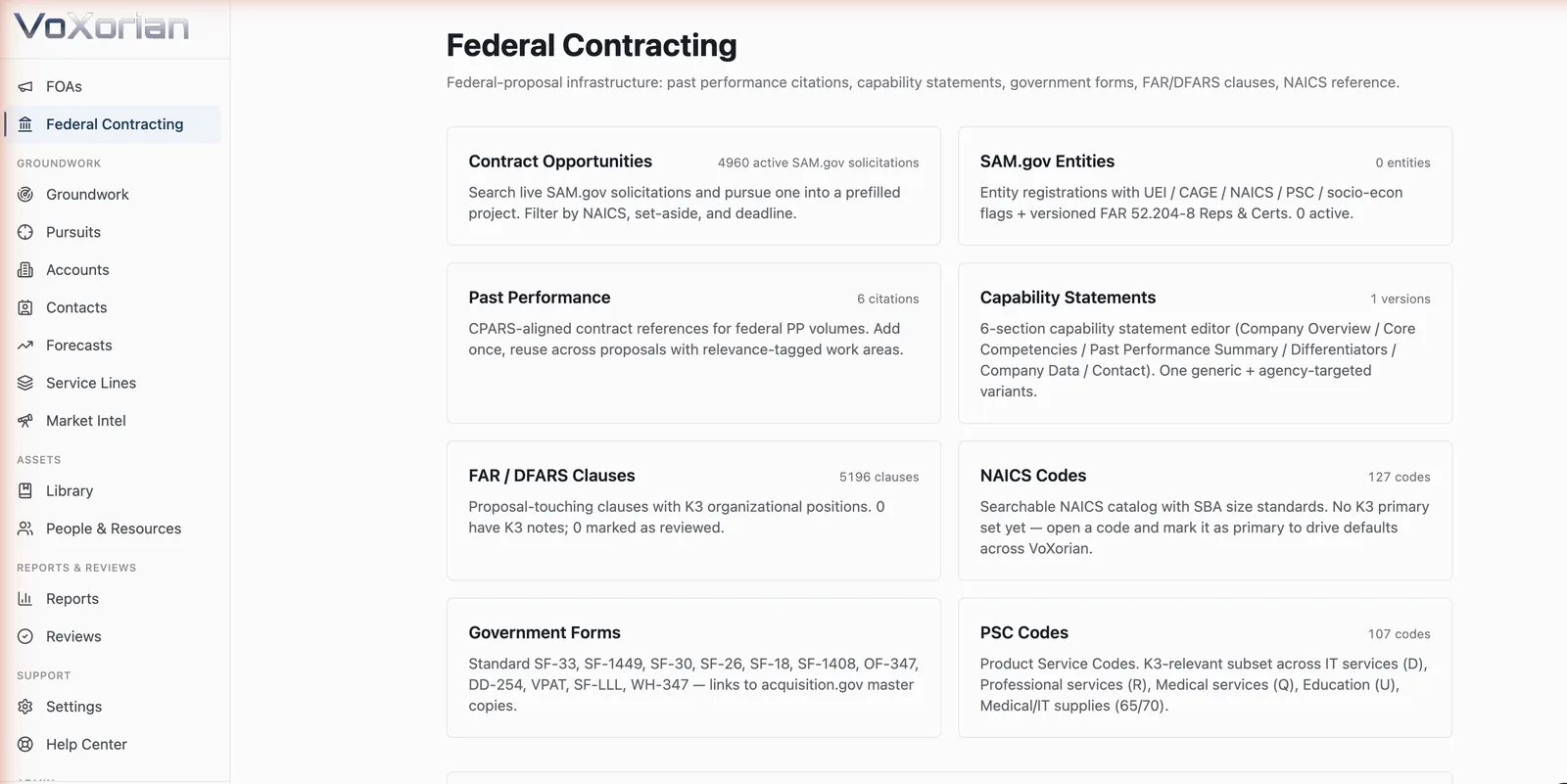
Government proposals are won and lost on two things: compliance and time. A solicitation arrives with Section L telling you how to write it and Section M telling you how it will be scored, plus a stack of FAR and DFARS clauses that can disqualify a bid on a technicality. Teams spend the first days building a compliance matrix by hand and the last nights digging through old proposals for content they can reuse. There is one deadline and one shot.
VoXorian does the mechanical parts and keeps the writing honest. It ingests the solicitation and turns Section L and M into a compliance matrix you can track. Then a set of specialised agents goes to work: writers draft each section from your approved content library, a compliance agent flags any "shall" the draft hasn't answered, and a judge — running a different model than the writer — re-reads every citation before it passes. Each agent has a fixed set of tools and hard limits on how long it can run and how many helpers it can spawn, so nothing wanders off.
Because the whole point is trust, every generation is written to an append-only log with the model, the prompt, and the sources it used. Some signatures — perjury certifications, officer attestations, anything that executes a contract — are non-delegable in the code, so an agent can never sign them for you. K3 Innovations was the first team to run on it, and the standards stay federal even when the pursuit isn't.
Specification
// SG-VOX · datasheetWhat's inside
// VoXorian · modulesOpportunity discovery
Aggregated from SAM.gov, Grants.gov, USAspending, and NIH data, ranked by semantic fit to your service lines — on free public sources, with no paid data vendor required.
Capture
Accounts, contacts, pursuits, and forecasts, with capture briefs, call preparation, and win themes worked out ahead of the RFP.
Compliance matrices
RFP requirements extracted automatically into a Section L/M matrix, with clause matching against a seeded FAR and DFARS library.
Grounded drafting
Section-by-section generation from your library, with a citation and a confidence signal on each passage, then color-team reviews and gate decisions.
Federal reference data
610 FAR and 447 DFARS clauses, NAICS and PSC codes, SAM entity data, past performance, and government forms, seeded in.
Grants & SLED
Funding announcements, biosketches, and NIH/NSF budget generation; state and local pursuits with bonds, certifications, and cooperatives.
Agent system
Thirteen specialised agents — section writer, researcher, compliance, color team, judge, submission preparer among them — each with a defined tool set and hard limits.
Submission
Package assembly with narrative and required forms, plus exports to Word, Excel, and HTML including RACI and redacted variants.
In production
// what's running todayThese are counts from the running product, not a roadmap. The design bias is the one that shows up across everything we build: give the machine a lot of capability, then box it in hard.
MOD-03 · Orchestration · ● Live
SyliFlow
Run your company like a much bigger one: a workforce of AI agents on an org chart, doing real work, with people holding the approvals.
The interface
// SG-SYLI · screen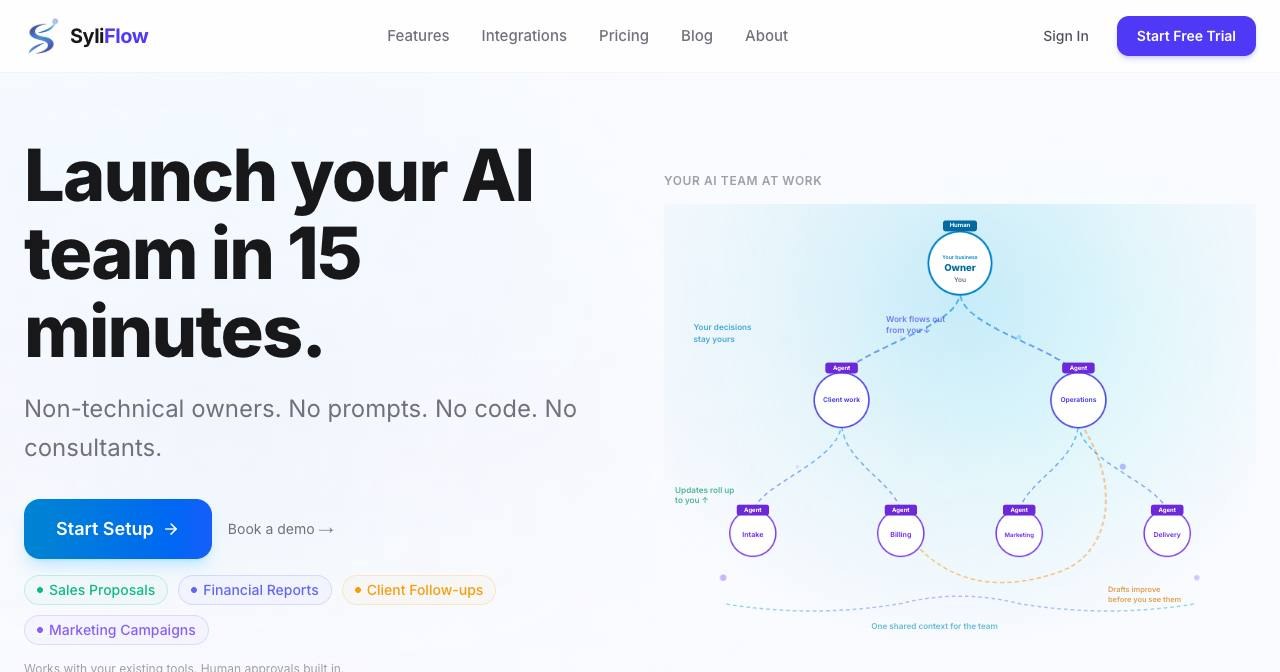
A growing company needs the coordination of a big one without the headcount or the bureaucracy, and more of that coordination now runs through AI agents. The catch is that agents don't get tired or bored, which sounds great until one gets into a loop. We learned this the hard way. An early version spun up around thirty thousand tasks in a single morning and ran up a real bill before anyone noticed.
SyliFlow is the structure that keeps that from happening. Agents are grouped into departments and an org chart, the same way people are. Work assigned to a manager routes down the chart to the right individual agent, and that routing costs nothing: the rule is one task, one model call. Each agent runs a short, bounded loop with a fixed tool set, and any code it writes executes in a sandbox with no network and no filesystem. You can drive the whole thing in plain language through Nova, the command agent — delegate a task, schedule one, approve one, or stand up a new agent.
Two things make it safe to actually use. A per-organization budget is checked before every model call, so spend can't run away the way it did that first morning. And a grounding policy, written as code and enforced both at runtime and in the build, stops an agent from stating a number, a name, or a "live" metric that isn't in the data it just saw. Anything that sends, submits, or signs waits in a human queue, and every step is recorded with the tokens and cost it used.
Specification
// SG-SYLI · datasheetWhat's inside
// SyliFlow · modulesDepartments & org chart
Agents grouped with roles, skills, and managers. Work assigned to a manager routes down the chart to the right individual agent.
Nova command agent
Run the whole workforce in plain language — delegate a task, schedule one, approve one, or stand up a new agent.
Visual workflow builder
Drag-and-drop DAGs with agent tasks, approval gates, conditions, waits, and triggers, so a process runs the same way every time.
Bounded agent loop
A short act–observe–reflect loop with a fixed tool set and hard caps. One task means one model call — routing costs nothing.
Cost circuit breaker
A per-organization daily budget is checked before every call. Over-budget work fails cleanly instead of quietly running up a bill.
Dual-language sandbox
Agent code runs as JavaScript or Python in a sealed sandbox with no network and no filesystem, a fresh context each time.
Grounding policy
An anti-fabrication policy, enforced at runtime and in the build, stops an agent stating a number or name it can't back with data it just saw.
Six providers, one runtime
OpenAI, Anthropic, Gemini, DeepSeek, Mistral, and local Ollama behind one loop, with a human queue gating anything that sends or signs.
In production
// what's running todayNone of this makes the agents less capable. They still browse, write code, call tools, and consult each other. It makes them accountable, which is the part most agent demos quietly skip.
MOD-04 · Consumer · iOS & Android · ● Live
Throttle Rides
Plan the twistiest way there, then ride it on Google Maps. Throttle finds the curves; your phone still does the navigating.
The interface
// SG-THR · screen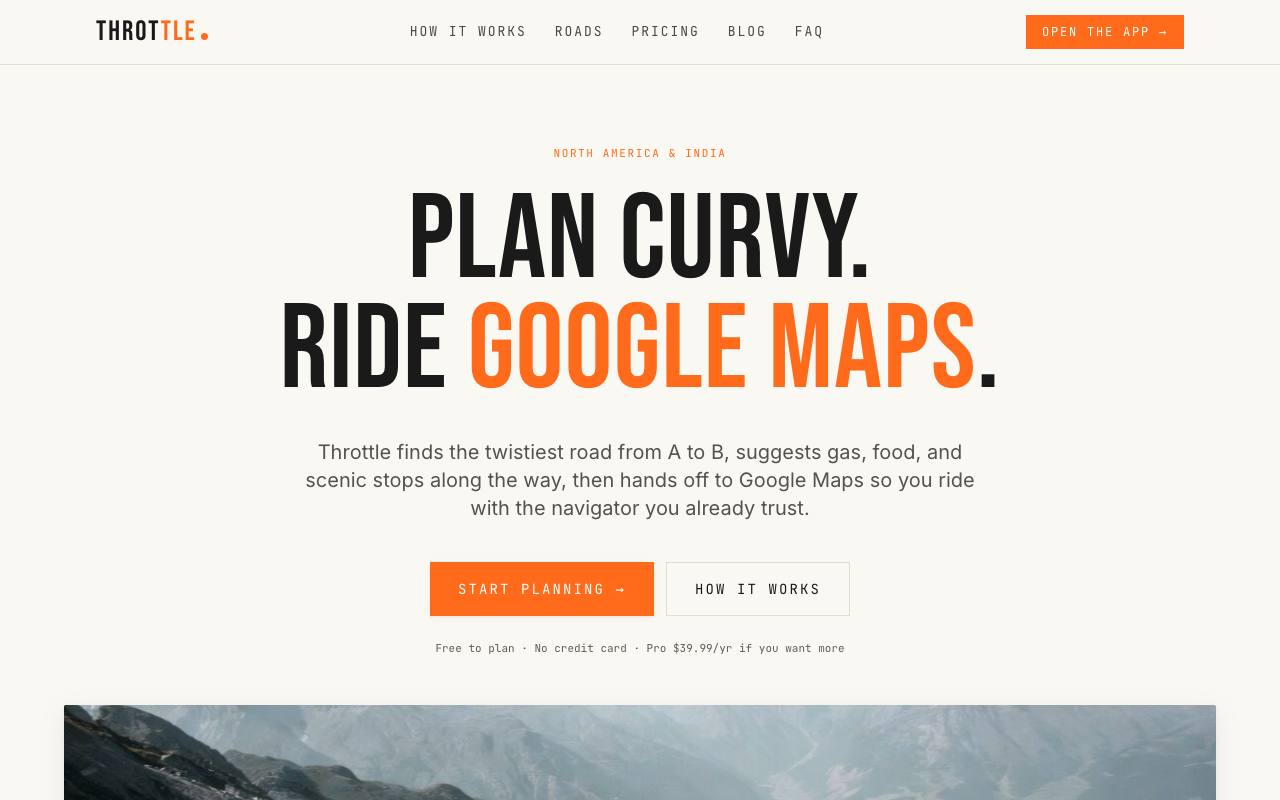
Every navigation app is built to save you time, which means it hands you the straightest, dullest road it can find. Riders want the opposite — the road with the most corners and the best views — and there has never been a clean way to plan one and then navigate it, because the good curvy route lives in one app and the turn-by-turn lives in another.
Throttle plans for the corners. Under it is a customised routing engine with four cost models, from "fast" to full "twisty," so you choose how much time you're willing to trade for fun. A separate planner places your fuel and rest stops, treating it as a shortest-path problem with rewards along the way, and respecting both your tank range and the fact that Google Maps only accepts nine waypoints. Then comes the trick that makes it usable: Throttle drops invisible shaping points along the route, so when it hands off to Google Maps, Maps is forced onto the exact curvy roads Throttle chose instead of straightening them back out.
The result is a route you'd never get from a maps app, navigated in the maps app you already trust. It runs on iOS and Android from one codebase, on top of a database of roughly 760,000 points of interest, with four fallbacks so a ride always generates. There is an AI planner for describing a ride in words, but the whole app works with it switched off. Throttle is the studio's proof that the same engineering shows up in a consumer app people use for fun, not only in the regulated work.
Specification
// SG-THR · datasheetWhat's inside
// Throttle · modulesCurviness cost models
Four routing profiles, from fast to full twisty, change what the engine optimises for — corners and elevation instead of minutes.
Smart break planner
A dynamic-programming planner places fuel and rest stops as a shortest-path problem with rewards along the way.
Google Maps hand-off
Invisible shaping points pin the route to the exact curvy roads Throttle chose, so Maps navigates them instead of straightening them out.
Points-of-interest database
About 760,000 points of interest feed routing, stops, and the scenery scoring behind a good ride.
Waypoint & range aware
Routes respect your tank range and Google Maps' nine-waypoint limit, so what you plan is what you can actually navigate.
Cross-platform
Native iOS and Android built from one Capacitor codebase, over a FastAPI and PostgreSQL back end.
Four-tier fallback
If one routing path fails, others take over, so a ride always generates.
Optional AI planner
Describe a ride in words and an assistant builds it — but the whole app works with the AI switched off.
In production
// what's running todayThe clever part isn't a big model. It's a small routing trick — invisible waypoints — that gets an off-the-shelf maps app to do something it was never meant to.
MOD-05 · Quality & training · ● Live
acaDMY
The eQMS an auditor actually wants to see — quality, controlled documents, and workforce qualification in one system of record, with compliance evidence on demand.
The interface
// SG-ACAD · screen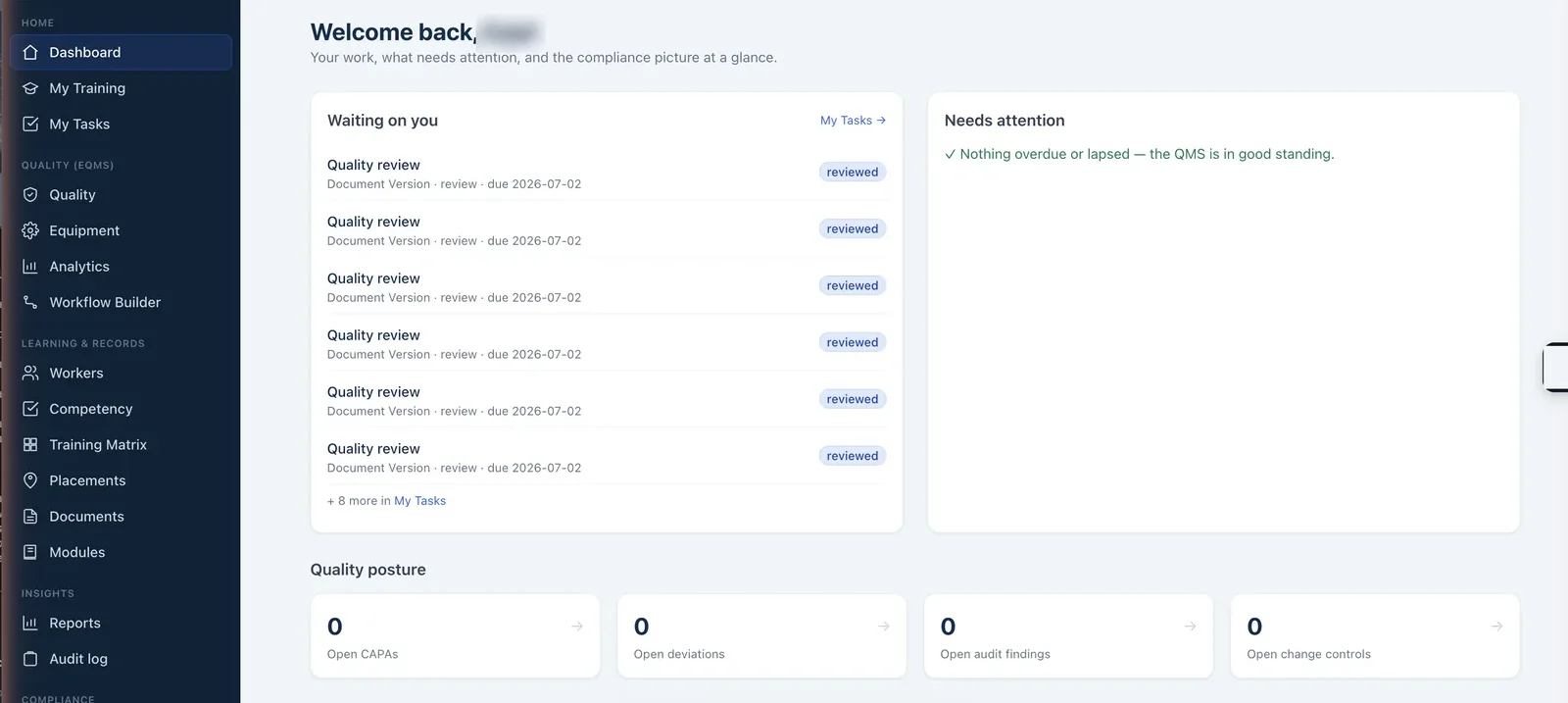
acaDMY is the system of record for how a GxP organization stays in control. Change control, CAPA, deviations and nonconformances, audits, risk, complaints, and supplier management all run on one configurable workflow engine, each step electronically signed, each record tamper-evident on a per-tenant hash chain. It's the software an auditor actually wants to see: not a binder describing intent, but the live system that enforces it.
Around that quality core sit controlled documents and workforce qualification. In clinical research these are inseparable from quality, so they live in the same platform instead of three disconnected tools. Documents move from draft to review to approval with electronic signatures, immutable versions, and periodic review; approving a new version automatically resets acknowledgements, so retraining follows the document without anyone remembering to chase it.
Its most distinctive control is the site-ready gate. A worker moves from assigned, through training, to site-ready only when every required document and module is complete and in date. So when a sponsor or inspector asks whether the people on a study are qualified, the answer is a report produced on demand — and trusted when it is.
What's inside
// acaDMY · modulesQuality management
Change control, CAPA, deviation, audit, risk, complaints, and supplier management — each electronically signed, with escalation into CAPA. The GxP quality processes, running as software.
Controlled documents
Draft to review to approval with e-signature, immutable versions, and periodic review. Approving a new version resets acknowledgements, so retraining follows the document automatically.
Workflow builder
A no-code builder for approval workflows: immutable versions, ordered steps, role-routed tasks, due dates, and per-step signatures — so the QMS matches your SOPs, not the other way round.
Inspection readiness
Unified task queues, analytics on open and overdue items, and inspection-readiness reporting — the one-click evidence that turns an audit into a report.
Training & qualification
Course authoring with SCORM and xAPI content, recurring cadences, and curricula resolved automatically from role, state, and client site — a requirements grid, not a spreadsheet.
Site-ready workflow
A guarded state machine covering assignment, training, review, site-ready, time-boxed exceptions, expiry, revocation, and offboarding.
Part 11 & tamper-evidence
Identity taken from the account, re-authentication at signing, recorded meaning, and a per-tenant hash chain with an independent verifier — append-only, tamper-evident records.
Worker records
Completion records, competency, signatures, retention rules, and legal holds — with a one-click audit-evidence packet per worker.
Specification
// SG-ACAD · datasheetIn production
// version 1.8, running K3's complianceacaDMY runs K3 Innovations' own quality and training. The compliance evidence isn't a promise on a slide; it's a packet the system generates on demand, which is the whole reason to build a QMS as software instead of a binder.
MOD-06 · Program delivery · ● Live
Command Center
The operating system a services company runs its delivery on — every program, deliverable, risk, and dollar in one live picture, so problems show up in the data weeks before they'd show up in a status meeting.
The interface
// SG-CMND · screen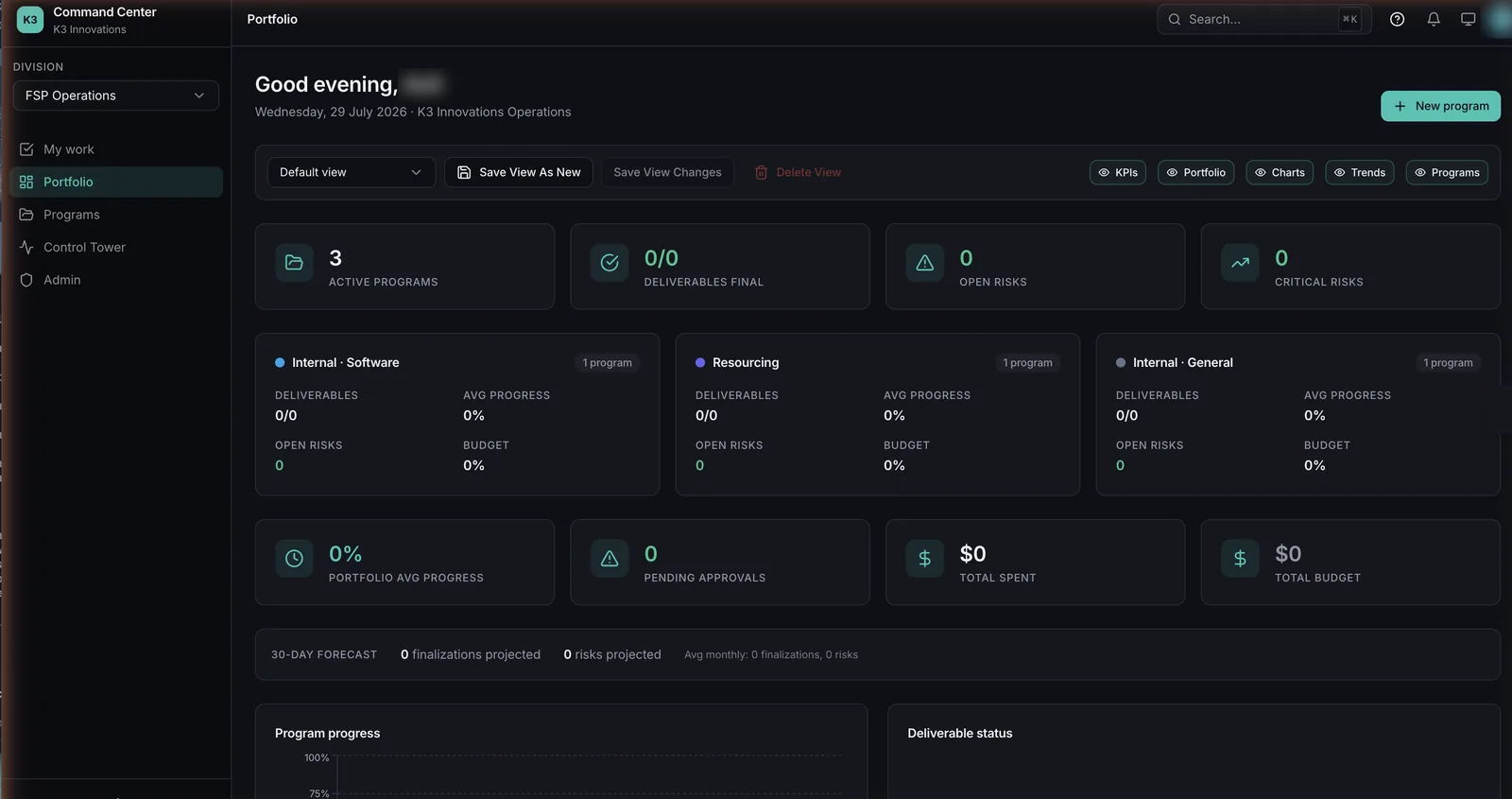
Most delivery problems are visible in the data long before they reach a status meeting. Command Center exists to close that gap. It tracks the whole delivery chain — studies, deliverables, quality control, milestones, risk, and cost — and surfaces the exceptions instead of waiting for someone to assemble a slide.
It's built around the way services work is actually contracted. Every program carries its own delivery model, and the system adapts: an FSP engagement, a fixed-scope project, and a resourcing placement each get different views, different service levels, and different metrics.
The payoff is one source of truth. Delivery status, open risks, and upcoming milestones are the same records leadership works from — not a client-facing summary produced after the fact. Where it helps, AI reads the live data ahead of the meeting: predicting delivery risk, flagging timesheet anomalies, and drafting governance narratives for review before they reach a client.
What's inside
// Command Center · modulesDelivery chain
Studies to deliverables — SDTM, ADaM, TLF, narratives, ISS and ISE — each moving through layered QC records and into governance reporting.
Milestones & scope
Milestone tracking with dependencies, task execution on a Kanban board, sprints, releases, and a maintained backlog.
Risk register
Risks scored by probability and impact, tracked to resolution, with automated daily checks that flag critical scores and overdue items.
Budget & contracts
Contract value, forecasts, and cost-versus-contract views — revenue and margin visible per program.
Timesheets
Draft, submitted, and approved states with service-level tracking — in variants that reflect FSP versus resourcing realities.
Resourcing chain
Requisitions to placements to timesheets to cost, alongside resource allocation, team capacity, and recruiting metrics.
Governance engine
Approval chains with delegation and multi-level escalation, approval policies, scheduled reports, and governance-meeting records.
Portfolio review
A recurring operating cycle that computes metric snapshots and exceptions — SLA breaches, missing submissions, aging deliverables — for weekly and monthly review.
Specification
// SG-CMND · datasheetIn production
// running K3's own deliveryCommand Center runs K3 Innovations' own program delivery. The same records its leadership works from are the ones a client can open — which is the whole point: not a status deck assembled after the fact, but the live system, shared.
// What we do
We build the software the work runs on.
Sparcgen is a software studio. We engineer production-grade, AI-native systems — our own products, and custom software for teams whose work can't afford to be wrong.
Most of what we do starts as someone else's hard problem: a process that's too manual, too slow, or too risky to leave to spreadsheets and good intentions. We build the system that fixes it — the model, the agents, the data, and the production software around them — and then we run it. Five of those systems grew into products you can buy today; others we build and operate for a single client.
What ties it together is a standard. A lot of our work has to survive an audit, so reproducibility, governance, and knowing exactly what the software did aren't features we bolt on at the end — they're how we build from the first commit. That standard doesn't switch off when the domain gets easier, which is why a proposal platform and a motorcycle app are engineered as carefully as a clinical one.
What we build
// capabilitiesAI-native product engineering
Whole products, not prototypes — the model, the agentic layer, and the production software around them, built to run for years.
Agentic systems
Bounded, governed multi-agent systems: tool allowlists, hard caps, cost limits, and a human in the loop, so autonomy stays accountable.
Regulated & compliant software
21 CFR Part 11 e-signatures, tamper-evident audit trails, and validated release — built into the architecture, not bolted on.
Retrieval & knowledge
RAG and CAG over your own content, pgvector search, and knowledge graphs, so generation is grounded instead of guessing.
Data & execution platforms
Deterministic pipelines and containerised R, SAS, and Python execution on rails that keep results reproducible a year later.
Build, run, support
We take a problem from first sketch to production, then operate and support it — the same way we run our own products.
How we work
// the rules, not the posterDeterministic by design
Toolchains are pinned and inputs are content-hashed, so a run rebuilds a year later down to the same bytes. AI speeds the work up; determinism is what lets you still trust the result long after the model that helped write it has moved on.
Governed by default
Who can do what, what changed, and who approved a release are enforced by the system, not left to a wiki page and good intentions. Every action ties back to a person, and the record is append-only, so it can't be quietly rewritten later.
AI where it earns its place
A model drafts, generates, and researches, but always inside structured metadata and hard guardrails, and its output is reviewed by a person or checked by a separate system before it counts. We don't ship an agent as an opaque oracle you're asked to trust.
Grounded, or it doesn't answer
An agent doesn't get to state a number, a name, or a claim it can't tie back to real data it just saw. In some of our products that's a rule enforced in the build itself, so a change that would let a model make things up fails the pipeline.
Standards-native
We learn each domain's real standards — CDISC for clinical, FAR and DFARS for federal proposals — and build to them, so output is conformant because of how the system works, not because someone remembered to check.
We run on it first
Every product is used in a real business, usually ours or K3's, before anyone else is asked to depend on it. If it can't survive our own operations, it isn't ready to sell. Running software, not slideware.
What that looks like in practice
// principle → real feature// DEVELOPERS
Docs.
Build on Sparcgen products — API references, guides, and data-format specs. Start with SPARC.
Quickstart
// generate a validated ADaM dataset
1 — Authenticate
Requests use a bearer token scoped to your organization and study. Tokens never leave your environment.
export SPARC_TOKEN="sk_live_…"
2 — Request generation
-H "Authorization: Bearer $SPARC_TOKEN" \
-d '{ "spec": "adsl@v2.3", "source": "sdtm/dm,ex,ds" }'
3 — Response
"dataset": "adsl@run_418",
"conformance": { "cdisc": "pass", "rules": 430 },
"lineage": "9f2a…c1", "signed": true
}
// illustrative — endpoints/domains finalized with the SPARC team
// Company
A studio for software that matters.
Sparcgen designs, builds, and operates AI-native products across regulated and demanding domains — and runs its own business on them before selling them to anyone else.
Sparcgen is a small studio, not an agency. We don't hand over a deck and walk away. We build products, run them, and support the people who use them. Most shops do one slice of this: they advise, or they wrap someone else's API, or they research models that never leave a notebook. We do the whole thing — the system, the AI inside it, and the years of operation after launch.
The work started inside a clinical research organization, K3 Innovations, where the software had to stand up to audits and real submissions. That's still where a lot of it runs first. Once a product can survive a working CRO's operations, we know it's ready for someone else's. The rest of the portfolio grew out of the same engineering pointed at different problems: proposals, business orchestration, and — because we wanted it — the best road between two points.
What we believe
// three that decide the restShip it, then stand behind it
Working software in production is the only proof that counts. We build products meant to run for years, and we're the ones who onboard and support them.
Clinical-grade, everywhere
The reproducibility and audit habits we learned in a regulated setting go into everything, even the products no regulator will ever look at. It's cheaper to build things right than to explain later why they weren't.
AI with its hands where we can see them
We lean on models hard and box them in just as hard: grounded, governed, and checked by something other than themselves.
At a glance
// SG · company// Careers
Come build things that ship.
We're a small, senior team that writes real software and puts it into production. If you'd rather ship than sit in strategy decks, we should talk.
What it's like here
// small team, real ownershipYou own it end to end
From the model to the UI to the on-call. A small team means real scope, and your work is in front of users, not buried in a backlog.
Ship or it didn't happen
We measure ourselves in production, not in slides. Short path from idea to live, fast feedback, and real consequences.
AI is the craft, not the buzzword
You'll build agent systems, wire up retrieval, and ground them so they don't lie — applied AI, not a wrapper around someone else's API.
Rigor is the job
A lot of what we build has to survive an auditor. If you like doing it right — reproducible, governed, signed — you'll be at home.
Roles we look for
// titles are loose, shipping is notApplied AI / ML engineer
Fine-tuning, retrieval, agent systems, and evals — models put to work inside real products, with guardrails.
Senior full-stack engineer
Next.js / React and Python / FastAPI, owning features from the database to the UI in a domain that can't be wrong.
Platform / infrastructure
Postgres, queues, containers, execution services, and the deterministic, governed rails everything runs on.
Product engineer
Turning a regulated or gnarly problem into software people actually want to use — then supporting it.
Data / backend engineer
Pipelines, vector search, and the data models under the products, built to hold up.
Domain SME (clinical / federal)
You know CDISC, or FAR / DFARS, or GxP quality cold, and want to see it built into software.
How we hire
// no take-home theaterShow us what you've shipped
A repo, a product, a system in production beats a whiteboard puzzle. Bring the real thing.
Talk to the people you'd work with
You meet the engineers, not a panel of proxies. Real problems, real conversation.
Decide together
We're honest about the work and the stage. You should be too — fit goes both ways.
// CONTACT
Tell us what you're building.
Partnerships, product access, or a role on the team — a real person reads it.
Inquiries
Pick a reason and a real person routes it. Or write to support@sparcgen.com directly.
Products
For SPARC, VoXorian, SyliFlow, Throttle Rides, or acaDMY — ask here and we'll point you to the right place.
Careers
Small team, ships often. Tell us what you've shipped — see open roles.
Office
Sparcgen, Inc.
101 Morgan Lane, Suite 206
Plainsboro, NJ 08536
+1 732-226-1718